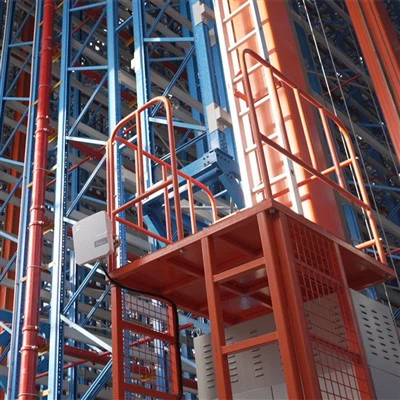
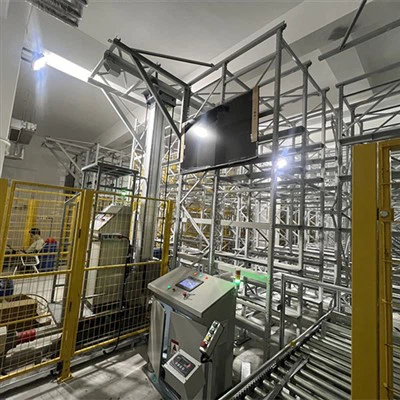
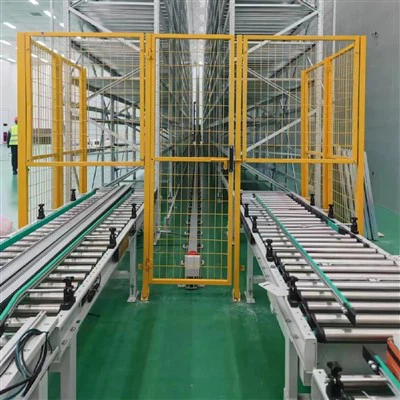
Shuttle racking systems are a common type of heavy-duty warehouse racking currently on the market. Compared to other types of warehouse racking, they offer high-density storage, significantly increasing storage capacity, and can be combined with different equipment while simultaneously meeting first-in, first-out (FIFO), first-in, last-out (FILO), or random access requirements.
When combined with different automated and semi-automated equipment, shuttle racking systems form several different shuttle systems. There are three common types of shuttle racking systems: bidirectional shuttle racking, mother-child shuttle racking, and four-way shuttle racking. These three types of shuttle racking systems are the result of continuous research and development by the warehousing and racking industry to meet the diverse needs of different industry clients and various storage requirements.
Bi-directional Shuttle Car
A bi-directional shuttle car is a semi-automated device used to transport goods between shelves. Operated by remote control, it has the ability to travel in both directions, running along shuttle tracks within the shelving aisles, sequentially transporting goods from the entry point into the shelves or retrieving goods from the shelves. Loading and unloading require control via remote control and a forklift.
Advantages: Compared to other pallet racking systems, bi-directional shuttle racking significantly improves warehouse space utilization. The shuttle car's loading and unloading capabilities greatly increase warehousing efficiency and reduce waiting times. It represents a semi-automated solution between traditional forklift-based manual storage and fully automated storage. Its storage rate and efficiency are higher than traditional floor stacking and other pallet racking systems, and its cost is far lower than automated storage systems, making it highly cost-effective, especially for large-volume storage.
Disadvantages: The shuttle car can only perform linear reciprocating motion and cannot automatically change levels or aisles, requiring human intervention and forklifts, which limits the improvement of warehousing efficiency.
Applicable scope: Widely used in manufacturing, logistics, e-commerce, and other fields.
Mother-Child Shuttle Car
The mother-child shuttle car is an upgraded version of the bi-directional shuttle car designed for four-way movement. Controlled by a computer system, the mother-child shuttle car consists of a mother car leading a series of child cars along the main aisle of the warehouse. When reaching a designated aisle, the child car can be automatically released and then independently carry out goods storage work in the aisle. The mother car continues to move forward during this process, significantly saving time and greatly improving work efficiency in the warehousing process.
Advantages: The mother-child shuttle car racking system overcomes the limitations of bi-directional shuttle car racking in terms of automated handling. The shuttle car is no longer limited to linear motion but can move in four directions (forward, backward, left, and right), and can automatically change levels and aisles, achieving a perfect combination of high-density storage and automation.
Disadvantages: The mother-child shuttle car is more complex in structure and composition, resulting in relatively lower system stability. It requires regular maintenance by professional personnel, and the implementation and maintenance costs are relatively high.
Applicable scope: Suitable for the transfer and transportation of various palletized goods, widely used in warehouses and logistics centers with a small variety of goods but large volumes.
Four-Way Shuttle Cart Racking System
This is an upgraded version based on the shuttle cart racking system. The four-way shuttle cart is equivalent to an intelligent robot, connected to the WMS system via wireless network. One cart can complete tasks such as picking, transporting, and placing goods. In conjunction with a lifting mechanism, it can access any storage location, enabling horizontal and longitudinal dual-track operation. Combined with RFID, barcode, and QR code identification technologies, it achieves automated identification and high-density storage. Furthermore, compared to shuttle carts and two-way shuttle carts, the four-way shuttle cart offers greater flexibility. For example, a shuttle cart can only operate on its own track; if the main cart stops working, goods next to it cannot be accessed. However, if a four-way shuttle cart stops working, the system can send instructions to other four-way shuttle carts to take over its tasks, allowing the warehouse to continue operating normally.
Advantages: The four-way shuttle cart can travel freely within the warehouse, directly reaching any designated storage location. This avoids the limitations of stacker cranes, which can only access goods on either side of the aisle, thus improving warehouse space utilization. It can be applied to warehouses with irregular shapes, large length-to-width ratios, high or low throughput efficiency, or those handling a small variety of large quantities or a large variety of large quantities of goods.
Disadvantages: The four-way shuttle cart requires planning for pallet sizes. If the size of stored goods changes later and exceeds the existing pallet size, it will render the system unusable. Because the four-way shuttle cart operates on the racking tracks, it is limited by the structure of the racking and the cart itself, unlike the storage method of stacker cranes, and therefore has certain load capacity limitations.
Applicable Scope: With its high efficiency, flexibility, and multi-functional features, the four-way shuttle cart racking system is suitable for various types of warehouses, including those in the food and beverage, pharmaceutical, e-commerce, automotive parts, apparel, and heavy industry sectors.